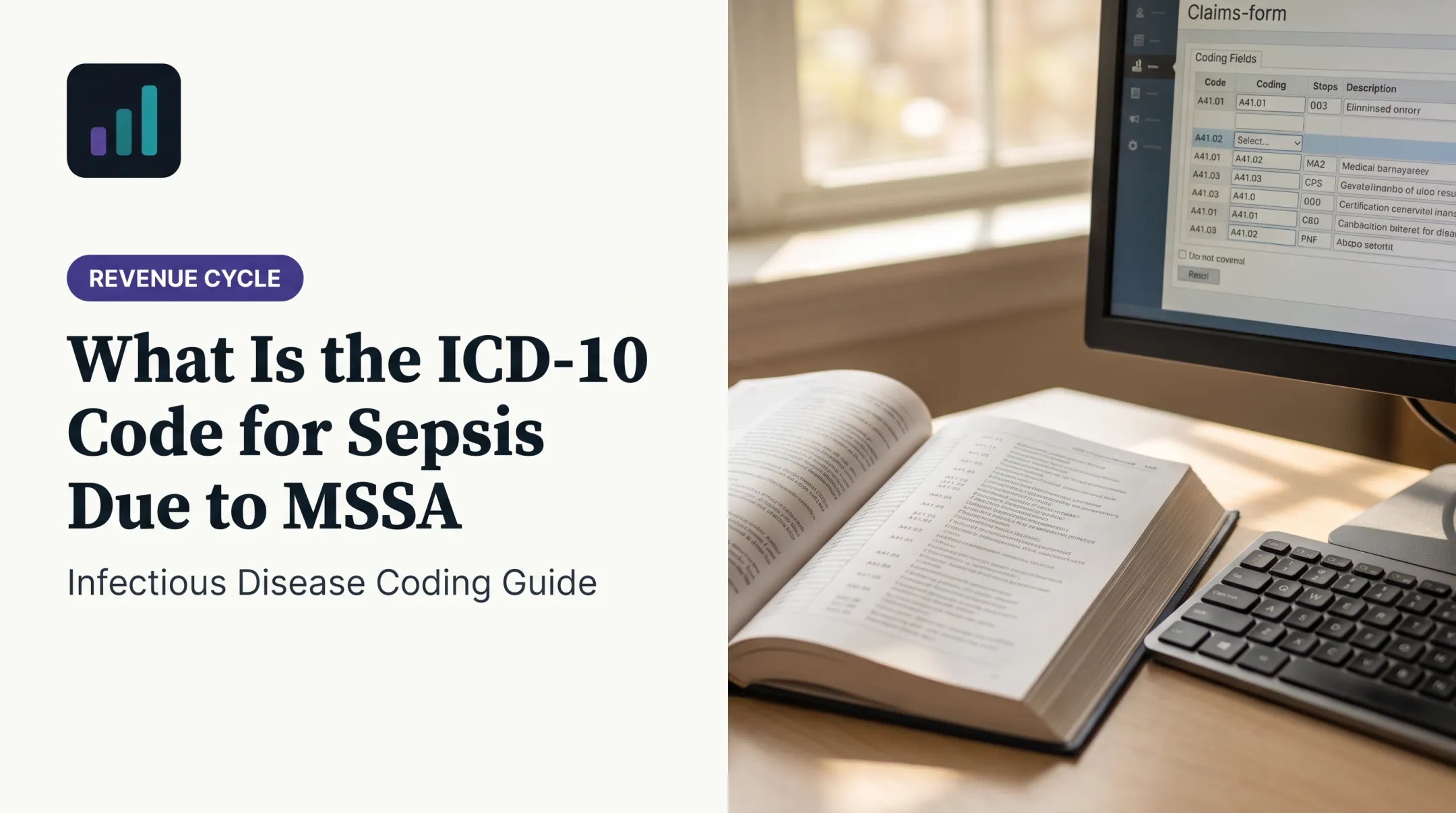

The code identifies methicillin-susceptible Staphylococcus aureus as the cause of a disease classified elsewhere in the ICD-10-CM manual. It almost never stands alone. If your claim shows B95.61 without a corresponding infection code for the site or condition, you've described the "who" without the "what" — and that's exactly where denials start.
This guide is written for infectious disease physicians, coders, billers, and practice administrators who need to get organism coding right the first time. Accurate pairing of B95.61 with the correct infection code affects claim clarity, medical-record integrity, quality reporting, and denial prevention. We'll walk through how to interpret the code, pair it correctly, verify MSSA specificity in the documentation, and audit the claim before it goes out the door.
Key Takeaways
- B95.61 is an "organism as cause" code that supplements, not replaces, the primary infection diagnosis
- The underlying infection and anatomic site must be coded per the current ICD-10-CM Index, Tabular List, and Official Guidelines
- MSSA is not MRSA; susceptibility must be explicitly documented before either code is assigned
- Billing teams should audit documentation, sequencing, and payer edits rather than treating B95.61 as proof a claim is complete
What B95.61 Means and When It Applies
B95.61 is defined as methicillin-susceptible Staphylococcus aureus infection as the cause of diseases classified elsewhere. Break that phrase apart and you get two separate clinical facts: an infection exists somewhere in the body, and the organism causing it is MSSA specifically.
Those are two different coding questions. The infection itself (a wound, a bloodstream infection, osteomyelitis, or a device-related infection) gets its own code based on site and condition. B95.61 gets added afterward to identify the causative organism, when the infection code doesn't already build that information in.

Why B95.61 Is an Additional Code, Not the Lead
Codes in this family exist to supplement an underlying condition code, not to replace it. In practice, that means:
- The principal diagnosis (inpatient) or first-listed diagnosis (outpatient) should reflect the documented infection or condition
- B95.61 follows that code, when the infection code itself doesn't already specify the organism
- A claim listing B95.61 as the only diagnosis is missing its foundation
B95.61 vs. B95.62: Don't Mix Up Susceptibility
| Code | Organism | Required documentation |
|---|---|---|
| B95.61 | MSSA | Record must state methicillin-susceptible or MSSA specifically |
| B95.62 | MRSA | Record must state methicillin-resistant or MRSA specifically |
| Generic S. aureus documentation | Unspecified | Neither B95.61 nor B95.62 applies without susceptibility documented |
A culture report that simply says "Staphylococcus aureus" without a susceptibility note doesn't support either organism code. Don't guess. If the record is ambiguous, that's a documentation gap to flag, not a coding decision to make unilaterally.
Code conventions, instructional notes, and payer edits shift from year to year. Always confirm the current-year ICD-10-CM Tabular List and Official Guidelines before finalizing a claim. Don't rely on last year's code book or a cached reference.
How to Code an MSSA-Related Infection Step by Step
Good organism coding starts with documentation, not with the lab report. Here's the sequence that holds up under audit:
- Identify the diagnosed infection. What condition did the provider actually document: cellulitis, bacteremia, osteomyelitis, a surgical site infection?
- Confirm the site or system involved. Anatomic specificity drives the underlying infection code; vague documentation leads to vague coding.
- Determine whether MSSA is explicitly documented. Look for the provider's diagnostic statement, not just a lab value.
- Check whether an organism code is permitted or required by the infection code's own instructional notes.
- Select the underlying infection code first, using the current Index and Tabular List rather than memorized or outdated codes.
- Add B95.61 when the documentation supports it, following the infection code's sequencing instructions.
Culture Results Aren't a Diagnosis
A positive MSSA culture tells you what grew in the lab. It doesn't tell you the provider diagnosed an active infection. Colonization (MSSA present on or in the body without causing illness) is clinically and coding-wise distinct from infection.
Before assigning B95.61, confirm the record shows:
- A provider-documented infection diagnosis (not just a lab value)
- Infectious disease consultation notes, operative findings, or discharge documentation connecting the organism to the clinical condition
- No conflicting documentation elsewhere in the chart
If the only evidence is a culture result with no provider interpretation, query the provider rather than coding from the lab slip alone.
Sequencing Depends on the Setting
Inpatient principal diagnosis rules and outpatient first-listed diagnosis rules aren't interchangeable. An inpatient discharge summary follows "condition established after study" logic. An outpatient encounter follows "reason for the visit, coded to the highest level of certainty available" logic.
Don't assume the sequencing you used on last week's inpatient claim applies to this week's outpatient infusion visit.
Resistance Codes Need Their Own Proof
Discussing antibiotics in the assessment and plan isn't the same as documenting resistance. Before adding any resistance-related code:
- Confirm the infection is explicitly documented as antibiotic resistant
- Check whether the infection code already identifies resistance (in which case, an additional code may not be needed)
- Never infer resistance from antimicrobial selection alone
Worked example (non-numeric): A patient has a provider-documented MSSA bloodstream infection secondary to an infected central line. The coder first assigns the underlying bloodstream infection code supported by current Tabular List instructions, confirms whether a device-related code applies based on documentation, and adds B95.61 because the record explicitly states MSSA.
No resistance code is added because nothing in the chart documents resistance. That's the discipline: underlying condition first, organism code second, nothing assumed in between.

B95.61 and Infectious Disease Billing Workflows
Diagnosis codes support medical necessity for the services wrapped around infectious disease care (E/M visits, antimicrobial management, follow-up monitoring, OPAT oversight, and infusion-related services). But medical necessity for the service, and justification for a diagnosis code, are two different compliance questions. B95.61 alone doesn't establish coverage for anything.
CMS treats medical necessity as a central payment criterion, along with the specific requirements for each CPT or HCPCS code billed. Documentation must support everything on the claim, according to CMS's E/M guidance. A perfectly coded B95.61 doesn't rescue a claim when the encounter note fails to justify the billed service.
Where B95.61 Sits in the Revenue Cycle
Think of the organism code as one checkpoint in a longer chain:
- Provider documentation establishes the infection, site, and organism
- Coder review confirms sequencing and code support
- Charge capture links diagnosis to the billed service
- Claim creation assembles everything for submission
- Payer edits check for logical and coverage consistency
- Denial follow-up catches what the edits missed
- Record correction closes the loop when documentation was incomplete
A break at any point in that chain (not just at the organism-coding step) produces a denial.
Claim-Risk Scenarios Worth Flagging
Watch for these patterns, which show up repeatedly in ID billing:
- B95.61 submitted with no underlying infection code attached
- MSSA coded when the chart only documents unspecified S. aureus
- MRSA and MSSA coded inconsistently within the same encounter
- A historical organism diagnosis carried forward into a current claim without current relevance
For infectious disease care, diagnosis-to-service linkage needs extra scrutiny when the encounter involves laboratory monitoring, antimicrobial therapy adjustments, line management, or infusion services. Those are the service types where organism documentation and billed codes must match the current encounter, not a prior one.
Rather than relying on generalized denial statistics, track your own practice's rework patterns. GrowInfectiousDisease's revenue-cycle guidance walks independent ID practices through reviewing their own coding, denial, and operational data to find where documentation or workflow (not the code itself) is the actual bottleneck. That kind of practice-specific review (not a published industry benchmark) is what actually reduces rework.
Documentation Requirements and Common Coding Errors
Strong documentation makes B95.61 defensible. Weak documentation makes it a liability. Before a claim goes out, confirm the record includes:
- The infection diagnosis itself, stated by the provider
- The anatomic site or affected system
- Organism identification, with MSSA susceptibility explicitly noted
- Clinical relevance of the organism to the current encounter
- Any device, postoperative, or complication relationship — only if explicitly documented
Errors That Keep Showing Up
| Error | Corrective action |
|---|---|
| B95.61 used as a standalone diagnosis | Add the underlying infection code; B95.61 supplements it |
| MSSA confused with MRSA | Verify the exact susceptibility wording before code selection |
| Suspected organism coded as confirmed | Confirm provider documentation states an established diagnosis, not a working or rule-out impression |
| Underlying condition omitted | Review the chart for the infection diagnosis before finalizing the organism code |
| Resolved infection copied into a current claim | Confirm active clinical relevance to the current encounter |
Pre-Submission Checklist
Before submitting a B95.61-related claim, compare:
- The assessment and plan against the codes selected
- Microbiology results against provider interpretation
- Discharge or consultation notes against code descriptors
- Sequencing against setting-specific rules (inpatient vs. outpatient)
- Code selections against current payer edits
Query the provider when the documentation is genuinely unclear. A quick clarification beats a denial and a resubmission cycle.
Compliance, Verification, and Practice-Level Quality Control
Organism coding guidance comes from a handful of authoritative sources. Treat these as the baseline for every claim:
- ICD-10-CM Official Guidelines for Coding and Reporting
- Alphabetic Index and Tabular List
- Applicable CMS materials
- Coding Clinic guidance
- Individual payer policies
Coding rules also aren't uniform across settings. Inpatient, outpatient, professional, facility, Medicare, Medicaid, and commercial claims each carry their own nuances. There's no single universal rule that covers every claim type an ID practice submits.
Running Your Own Audit
An internal audit doesn't need to be elaborate. Pull a small, representative sample of MSSA-related encounters and compare:
- Documentation against assigned codes
- Code assignment against claim edits
- Denials against the documentation that triggered them
- Corrected claims against the original submission
This is where practice-specific data matters more than industry averages. Persistex's practice reviews, for example, start from a practice's actual payment and denial data rather than generalized rates, because every practice's documentation habits and payer mix are different.
This article is educational and does not replace current coding guidance, a qualified coder's review, or payer-specific policy verification. ICD-10-CM, CMS requirements, and payer policies change; revisit this guidance whenever they do.
Frequently Asked Questions
What is the difference between buy and bill and white bagging?
Buy-and-bill means the provider purchases a drug, administers it, and bills the payer for reimbursement. White bagging means a specialty pharmacy ships the patient-specific drug to the provider, per AMCP's bagging definitions. Both are supply models, not factors in selecting B95.61.
Does Medicare allow buy and bill?
It depends on the drug, benefit category, care setting, and current CMS enrollment rules. Check Part B or Part D requirements directly; diagnosis coding alone does not prove coverage.
Is white bagging legal, and which states prohibit it?
Legality and restrictions vary by state, payer, drug, and care setting. Check current state statutes and payer policy before assuming a nationwide rule applies to your practice.
What does white bagging mean?
White bagging is when a specialty pharmacy ships a patient-specific medication to the administering provider or facility. It is a drug-supply arrangement and does not decide whether B95.61 is reportable for the encounter.