For infectious disease (ID) practices, the translation gets complicated fast. A single OPAT or infusion episode can touch diagnosis codes, procedure codes, drug codes, place-of-service codes, and facility revenue codes all at once. Get one piece wrong, and the whole claim can stall.
This article walks through the principal U.S. code systems — ICD-10-CM, CPT, HCPCS Level II, ICD-10-PCS, and the supporting claim fields that tie them together. It also covers how to choose and validate the right system for a given service, so your team spends less time reworking denied or delayed claims.
Key Takeaways
- ICD-10-CM reports the diagnosis, CPT reports most professional services, and HCPCS Level II covers drugs, supplies, and equipment outside CPT
- ICD-10-PCS applies to inpatient hospital procedures only, not outpatient or professional billing
- Revenue codes, place-of-service codes, modifiers, and units add claim context but never replace a primary code set
- Correct code selection follows documentation and payer rules, not habit or expected payment
- Connecting documentation, coding, claim review, and denial analysis into one process cuts avoidable rework
What Are Medical Billing and Coding Code Systems?
A code system is a standardized classification that represents a diagnosis, a procedure, a product, or a piece of claim context in a format every party in the transaction (provider, clearinghouse, payer) can read the same way.
The Department of Health and Human Services describes code sets as shared lists that replace long descriptions with common shorthand. That's the point: a payer's system doesn't process "complicated bacteremia requiring OPAT," it processes a code [CMS's code-set guide].
Coding and billing are related jobs, but they're not the same job:
- Coding translates the clinical encounter (the diagnosis, the service performed, the drug given) into the appropriate code or codes.
- Billing assembles those codes with patient, provider, service-date, and location information required to submit, adjudicate, and (if needed) appeal the claim.
Code systems aren't an interchangeable menu. Which one applies depends on:
- The care setting: office, hospital, home infusion, skilled nursing
- The type of service: diagnosis, procedure, drug, supply
- The claim form in use: CMS-1500 for professional claims, UB-04 for institutional claims
- Payer-specific rules layered on top of federal guidance
Code descriptions and annual updates change. ICD-10-CM gets a new fiscal-year release every October, HCPCS Level II updates quarterly, and CPT updates annually with some sections revised more often. Verify current-year scope against CMS guidance, official code books, and payer policy rather than trusting last year's reference sheet.

Why Are Code Systems Important in Infectious Disease Practice?
Diagnosis codes and procedure codes work as a pair. The diagnosis code explains why a patient was seen or treated; the service code explains what was actually done. A diagnosis code alone never guarantees coverage or payment. Payers still apply their own medical-necessity and coverage rules on top.
When codes are incorrect, incomplete, outdated, or mismatched against documentation, the consequences show up downstream: claim edits, denials, delayed payment, underpayment, and staff hours spent reworking claims that should have gone through clean the first time. MGMA's 2026 poll of medical-group leaders found denials and appeals to be the single biggest revenue-cycle leak, ahead of eligibility issues, timely filing, and payer errors.
ID practices feel this acutely because the specialty touches so many code systems in a single week:
- Office or inpatient consultations: billed through E/M codes, which depend on documented medical decision-making or time, not just the diagnosis on file
- Antimicrobial management: coding needs to reflect the actual clinical work performed, not just the presence of an infection
- Specimen-related laboratory services: professional and technical components may bill separately depending on who performed which part
- OPAT oversight: may combine E/M codes for monitoring with HCPCS codes for drugs and supplies, depending on setting
- Infusion encounters: governed by an infusion hierarchy (initial, subsequent, sequential) with specific documentation requirements
- Separately billed drugs and supplies: require accurate units, NDC information where applicable, and consistent reporting of any discarded drug
Verify current code and payer rules for each of these before billing; this list shows where coding complexity concentrates, not a fixed recipe.
Documentation specificity drives all of it. The record needs to support:
- The diagnosis, and its severity or complexity when relevant
- The service actually performed
- Time or units, when the code requires them
- The provider's role in the encounter
- The location of care and the medical necessity for the service
Recurring denials, missed billable services, incorrect units, and unworked accounts receivable all chip away at revenue-cycle performance over time. The exact financial impact depends on your payer mix and contract terms, not a generic industry number.

If you'd rather evaluate your own workflow than lean on someone else's benchmark, GrowInfectiousDisease publishes free, ungated practice-economics and revenue-cycle resources built for exactly that kind of self-assessment.
Types of Medical Billing and Coding Code Systems
No single code set describes an entire ID claim. Depending on setting, payer, and service, a claim might combine a diagnosis code, a procedure code, a drug code, and several supporting claim fields — each doing a distinct job.
ICD-10-CM: Diagnosis Coding
ICD-10-CM is the U.S. clinical modification used to report diagnoses, conditions, symptoms, and other reasons for a healthcare encounter. The CDC releases it annually, so confirm the current fiscal-year scope before coding a claim.
Code selection depends on documentation specificity: anatomic site, organism when documented, acuity, and whether the condition is confirmed, suspected, historical, or otherwise reportable under the rules for that setting.
Outpatient and inpatient rules differ here. Outpatient encounters generally shouldn't report a "probable" or "suspected" diagnosis as confirmed, while certain inpatient admissions allow coding an uncertain diagnosis as though established. That distinction alone causes real errors.
ICD-10-CM establishes clinical context and supports medical necessity, but it doesn't describe the procedure performed, the drug administered, or payment conditions. Those live in other code systems entirely.
A typical ID example: a documented infection-related evaluation or follow-up needs a diagnosis code specific enough to reflect what was actually assessed, not a generic placeholder chosen out of habit. Don't present a specific code without checking it against current official guidance first.
Common risks to watch for:
- Coding from assumption instead of documented findings
- Choosing an overly broad diagnosis when a more specific one is supported
- Missing clinically relevant specificity the payer expects
- Using a diagnosis that doesn't actually support the billed service under payer policy
ICD-10-CM is not ICD-10-PCS. The latter covers inpatient hospital procedures, not diagnoses, and it isn't a universal procedure code set.
CPT: Professional Procedures and Services
CPT is the procedure and service code set used to report most professional work: evaluation and management visits, consultations where applicable, laboratory-related professional services, and more. The AMA's CPT Editorial Panel maintains it on a generally annual cycle, with some sections — proprietary laboratory analyses among them — updated more frequently.
Code selection depends on the service performed, the setting, supporting documentation, and, for many E/M visit types, either medical decision-making or time. Modifiers and payer-specific instructions layer on top. CPT answers "what did the clinician do"; ICD-10-CM answers "why."
A short example: an inpatient consultation for a complex infection is coded based on documented medical decision-making or total time on the date of the encounter, tied back to a diagnosis code that supports why the evaluation was necessary.
Worth knowing: Medicare doesn't recognize the office/outpatient or inpatient consultation code ranges for Part B payment purposes. That's a payment-policy decision, not a statement about whether the service happened. Check payer-specific rules before assuming a code range applies.
Common trade-offs:
- Undercoding omits work the documentation actually supports, leaving revenue uncaptured
- Overcoding creates compliance exposure when the record doesn't back up the level billed
- Incorrect modifiers or duplicated service lines trigger edits or denials outright
CPT isn't a substitute for HCPCS Level II when the claim involves a drug, supply, or piece of equipment outside its scope.
HCPCS Level II: Products, Supplies, Drugs, and Other Services
HCPCS Level II is the alphanumeric code set CMS maintains for products, supplies, durable medical equipment, ambulance services, many drugs, and other items CPT doesn't fully cover. It updates quarterly, so a drug or supply code that didn't exist last quarter may now have one.
This matters directly to ID practices that administer medications, run infusion services, coordinate home-based care, or manage related supplies. Always verify payer-specific billing and documentation rules before assuming a code applies the same way across payers.
The code for a drug or item is only one piece of the claim. You also need:
- Units and dosage or quantity administered
- The administration service itself, billed separately from the drug
- National Drug Code information, when required
- Place of service
- Documentation supporting all of it
Home infusion illustrates this well. CMS's home-infusion benefit covers certain professional services (nursing, training, monitoring) delivered by a qualified supplier when a drug is administered through a DME pump in the home.
CMS identifies G0068, G0069, and G0070 as the professional-service codes for that benefit, separate from the J-codes used for the drug itself [CMS's home-infusion FAQ]. Not every OPAT or infusion claim qualifies for this specific benefit; verify the beneficiary, drug, pump, and supplier status before billing it that way.

Selecting the right HCPCS code doesn't establish coverage, acquisition cost, allowable payment, or margin. Those vary by payer, contract, and policy — none of it should be assumed from the code alone.
ICD-10-PCS, Revenue Codes, and Other Supporting Claim Fields
ICD-10-PCS classifies procedures performed in U.S. inpatient hospital settings. It's a facility code set, not a substitute for CPT, and physicians don't use it to report their own professional services — including inpatient visits.
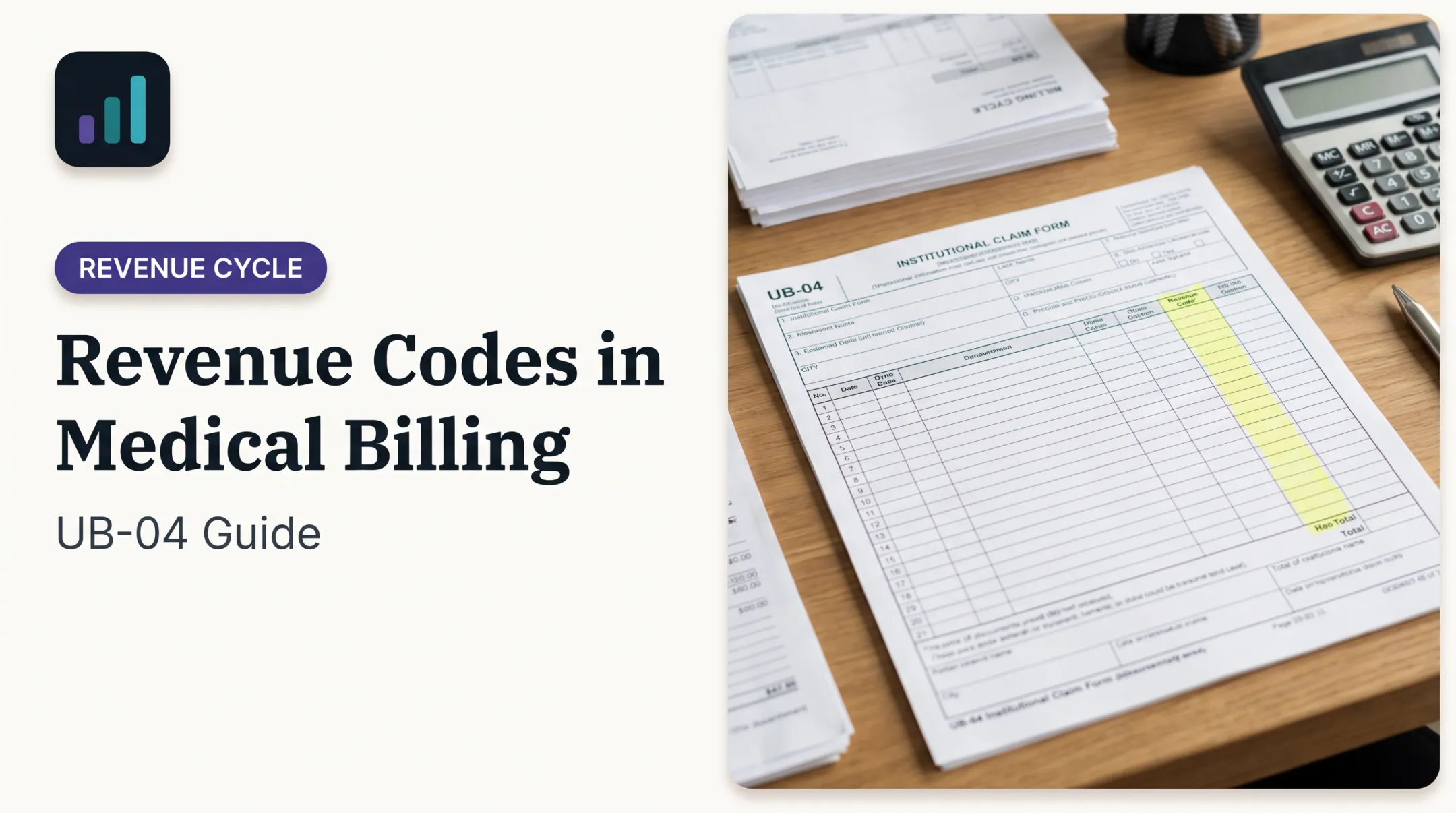
Revenue codes work differently again. They're facility claim fields that categorize broad service or department charges on institutional claims (the UB-04), and they complement, rather than replace, CPT, HCPCS, or diagnosis codes on that same claim.
Other supporting fields affect adjudication without being a primary code set themselves:
- Place-of-service codes identify where the service happened
- Modifiers add context to a procedure code
- Units quantify how much of a service or drug was provided
- Occurrence or frequency information applies on certain claim types
- Provider identifiers (NPIs) identify who rendered the service
Here's how the pieces line up:
| Code / field | What it communicates | Where it's used |
|---|---|---|
| ICD-10-CM | Diagnosis, reason for care | Professional and institutional claims |
| CPT | Professional service or procedure | Mostly professional claims |
| HCPCS Level II | Drug, supply, equipment, or service outside CPT | Professional and institutional claims |
| ICD-10-PCS | Inpatient hospital procedure | Institutional inpatient claims only |
| Revenue codes | Facility charge category | Institutional claims only |
Exact descriptions, sequencing rules, and required combinations change, sometimes quarterly. Check current official manuals rather than relying on a static list.
How to Choose and Validate the Right Code System
The right code system isn't the one that's most familiar or pays best on paper. It depends on the documented service, the care setting, the claim type, the payer, and what you're actually reporting.
Start With the Service and Setting
Before selecting any code, identify the setting: inpatient, outpatient, office-based, hospital-based, home-based, infusion-related, laboratory-related, or something else. Setting often determines which code system even applies.
Keep these elements separate rather than collapsing them into one decision:
- The reason for care (diagnosis)
- The service performed (procedure)
- The product or supply furnished (drug, device)
- The facility charge category (revenue code, if institutional)
- The provider or service location (place of service)
A single clinical episode (an OPAT start, for example) may require more than one code system working together. Don't select a code in isolation from the rest of the claim.
Match Codes to Documentation and Payer Rules
Check the medical record for the basics before coding anything: provider identity, service date, diagnosis detail, the procedure or service performed, units, dosage or quantity where relevant, location, and any supporting orders.
Then verify:
- Current-year code-set updates: ICD-10-CM annually, HCPCS Level II quarterly, CPT annually with some sections more often
- National Correct Coding Initiative edits, where applicable
- Medicare guidance specific to the service
- Commercial payer policies and contract-specific requirements
Claim scrubbing and pre-submission review should catch the issues behind most avoidable rework:
- Missing required fields
- Incompatible diagnosis-procedure combinations
- Invalid modifiers
- Duplicate services
- Incorrect provider roles
- Outdated identifiers
A clean pass through NCCI edits isn't a coverage determination. It's one control among several, not a guarantee the claim gets paid.

Review the Financial and Compliance Consequences
Track more than a general clean-claim impression. For each denial, capture the reason, the correction required, the payer, the service line, and the workflow step responsible. That level of detail turns denial data into a fixable pattern instead of background noise.
Never choose a code because it appears to produce a higher payment, or because "that's what we've always used." Coding follows documentation and applicable rules, not the reverse.
Periodic audits matter most in high-volume, high-risk workflows:
- OPAT oversight
- Infusion and drug administration
- Specimen-related laboratory services
- Split professional and facility billing
Bring in qualified coding or compliance review when documentation and code selection genuinely conflict, rather than guessing.
Verified coding requirements and your practice's actual reimbursement figures are two different things. Model your own revenue-cycle impact using your own claims and payment data, not a generalized number that may not reflect your payer mix.
Conclusion
Medical billing and coding systems each carry a different piece of the claim:
- ICD-10-CM reports the diagnosis
- CPT reports the professional service
- HCPCS Level II reports the drug, supply, or equipment
- ICD-10-PCS classifies inpatient hospital procedures
- Revenue codes categorize facility charges
None of them substitutes for another.
ID practices get the most accuracy and the most financial control when documentation, code selection, payer validation, claim scrubbing, and denial follow-up operate as one connected process rather than five separate tasks with no feedback loop between them.
Use current official guidance and your own practice data as the foundation for any coding decision. GrowInfectiousDisease's revenue-cycle and practice-economics resources are built to support that kind of evaluation, using your numbers instead of a borrowed benchmark.
Frequently Asked Questions
What is code billing?
"Code billing" generally refers to using standardized diagnosis, procedure, product, supply, and claim-context codes to prepare and submit a healthcare claim. Coding and billing are related but distinct steps: coding translates the encounter, billing assembles the submittable claim.
Is billing and coding difficult?
The work requires close attention to documentation, frequently updated code sets, and payer-specific rules, so it takes real training to do well consistently. Structured reference materials and routine quality review make the process manageable even as codes change each year.
What is the golden rule in coding and billing?
Codes must accurately reflect the documented service and condition: no upcoding, no downcoding, no coding from assumption. Always verify your code choice against current official guidance and the specific payer's policy before submitting.
What is the difference between ICD-10-CM, CPT, and HCPCS?
ICD-10-CM generally reports the diagnosis or reason for care. CPT reports most professional services and procedures. HCPCS Level II reports many drugs, supplies, equipment, and services outside CPT's scope.
Are revenue codes the same as CPT codes?
No. Revenue codes categorize facility charges on institutional claims, while CPT codes describe specific professional services and procedures. They often appear on the same claim but aren't interchangeable.
How do incorrect codes affect an infectious disease practice?
Incorrect codes can trigger claim edits, denials, delayed or incorrect payment, compliance risk, and staff rework. The exact financial effect still depends on documentation, payer policy, contract terms, and internal workflow.