
For ID practices, that catch-all shows up often. Consults, hospital follow-up, OPAT oversight, infusion administration, and laboratory coordination all carry layered documentation and payer rules most specialties don't deal with. A missing modifier, an expired authorization, or a mismatched diagnosis code, and the claim bounces back flagged CO-16.
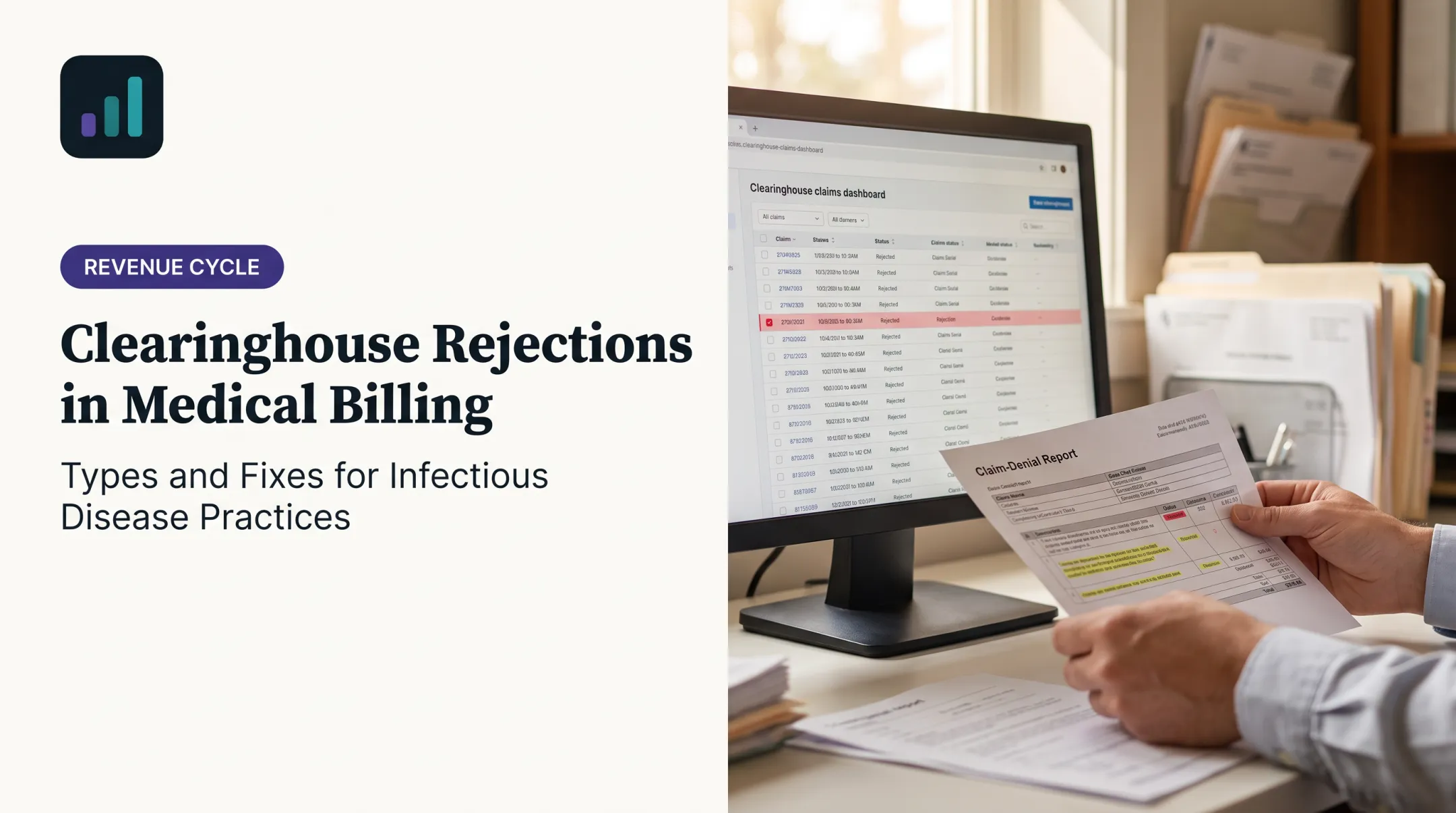
This article walks through a repeatable workflow: read the accompanying payer message, pinpoint the actual claim defect, fix the claim or file an appeal, and track the outcome. CO-16 by itself won't tell you what's wrong. The message attached to it will.
Key Takeaways
- CO-16 is broad; the RARC or payer remark explains what actually needs correcting
- ID claims often fail on coverage data, diagnosis mismatches, enrollment, modifiers, or authorization
- Correct and resubmit admin errors; appeal when the claim was accurate or necessity is disputed
- Track denials by payer, provider, service, and root cause to stop repeat revenue loss
What Is CO-16?
CO-16 combines two separate pieces of information, and mixing them up is where a lot of confusion starts.
CO is the group code. In X12's claim adjustment group codes, CO stands for Contractual Obligation: the payer is assigning responsibility for the unpaid amount to the provider, not the patient.
16 is the reason code attached to it: "Claim/service lacks information or has submission/billing error(s)." That's the official language from X12's code set, and it's deliberately generic. CARC 16 requires a supplemental remark: either an NCPDP reject reason or a remittance advice remark code (RARC) that isn't just an informational alert. Without that remark, the code tells you almost nothing.

CO-16 Doesn't Explain the Diagnosis
It's tempting to read CO-16 as "something's wrong with the diagnosis." That's not accurate. The code excludes claim attachments and documentation issues by definition, and it says nothing about medical necessity on its own. The RARC sitting next to it on the ERA does that work: identifying the missing field, the invalid code, or the documentation gap.
Rejection or Denial? Check Claim Status First
Before you touch the claim, confirm what actually happened to it:
- Unprocessable submissions aren't treated as claims at all. They carry no appeal rights: you simply submit a corrected, complete claim.
- Denials are payment determinations made after adjudication. These are appealable.
Appearing on an ERA doesn't automatically mean a claim was denied in the appealable sense. Some incomplete submissions get returned through the remittance process without ever being adjudicated. Check your clearinghouse report and payer portal status before deciding whether you're correcting a claim or appealing one.
Common Reasons Infectious Disease Claims Receive CO-16
CO-16 usually points to a specific mismatch, not one universal cause. The fix starts by locating exactly where the data broke down: the claim header, a single service line, or a payer-specific policy rule.
Missing or Inconsistent Patient and Insurance Information
Member ID typos, outdated eligibility, wrong subscriber relationship, or coordination-of-benefits errors trigger CO-16 constantly. For OPAT, infusion, and post-discharge services, this matters even more because coverage often shifts right at the transition point.
- Incorrect or expired member ID
- Wrong payer sequence when coordination of benefits applies
- Coverage dates that don't match the actual date of service
- Referring or ordering provider details that don't match enrollment records
Verify eligibility and referral details before billing anything tied to a hospital discharge or OPAT start.
Coding, Diagnosis, and Medical-Necessity Mismatches
Common coding triggers include:
- Vague or nonspecific diagnosis codes
- Diagnoses that don't support the billed CPT or HCPCS service
- Invalid code combinations under payer edits
One ID diagnosis does not automatically justify a particular CPT or HCPCS code. Payer policy determines that link, and it varies by plan. Check current coding guidance and payer-specific medical policy before assuming a code pairing is safe.
Provider, Facility, and Claim-Identification Errors
ID practices bill across hospital, office, home, infusion-center, and laboratory settings, and each one carries different claim requirements. A rendering NPI not linked to the group NPI, a taxonomy mismatch, or an incorrect place-of-service code all land under CO-16.
- Rendering NPI not associated with the billing group
- Missing or incomplete ordering/referring provider information
- Taxonomy code inconsistent with payer enrollment
- Place of service that doesn't match where the service happened
Missing Modifiers, Authorization, or Service-Line Details
OPAT monitoring, infusion administration, and prolonged evaluation and management services all depend on precise service-line detail. These gaps commonly surface as CO-16:
- Missing or incorrect modifiers
- Authorization that lapsed mid-course
- Mismatched units
- Missing start/stop documentation
Duplicate, Corrected, or Improperly Resubmitted Claims
Resubmitting a claim without updating the frequency code, or without referencing the original claim control number, often creates a second problem on top of the first. A true corrected claim uses the proper frequency indicator and keeps the original reference. A duplicate resubmission does neither.
How to Fix a CO-16 Denial: A Step-by-Step Workflow
Don't just rebill the same claim. Figure out exactly what's missing or inconsistent, and whether it affects the whole claim or one line, first.
- Confirm the denial and collect the payer details. Review the ERA, EOB, clearinghouse response, and any RARC. Record the claim control number, date of service, billed line, adjustment amount, and filing deadline.
- Classify the root cause. Sort the issue into a category: patient/coverage data, coding/diagnosis, provider enrollment, authorization, documentation, modifier/units, place of service, duplicate claim, or payer processing error. Assign it to the right owner: billing staff, coder, clinician, authorization team, or payer support.
- Correct the claim or supporting record. Fix the specific defect identified. Clinical documentation must reflect the service actually performed. Never alter a record or add a code solely to force payment through.
- Choose the correct submission route. Decide between a corrected claim, a records submission, or a formal appeal. Keep a checklist:
- Original claim reference
- Corrected data
- Supporting documentation
- Confirmation of successful transmission
- Track, reconcile, and close the issue. Monitor the claim through the payer portal, clearinghouse, and A/R work queue. Record every date and outcome, and escalate before the filing deadline passes.

This sequence is also where GrowInfectiousDisease's claims management and A/R follow-up work tends to add the most value for ID practices: clearing rejections, documenting every touch on an aging claim, and reporting exactly why a claim stalled.
Corrected Claim vs Appeal: Common Mistakes and Prevention
The right response depends on why CO-16 showed up. A correctable data defect usually calls for a corrected claim. A payer disagreement, or an underpayment despite accurate documentation, calls for reconsideration or appeal.
When to Correct and Resubmit
These typically warrant a straightforward correction, subject to payer rules:
- Incorrect member ID or provider identifier
- Missing or wrong modifier
- Incorrect place of service or billing units
- Wrong diagnosis pointer or claim frequency code
Submit through the payer's approved correction route and keep proof of transmission.
When to Appeal or Request Reconsideration
Appeal when the data was accurate but the payer disputes medical necessity, authorization, or coding interpretation. Confirm the payer's appeal levels, deadlines, and evidence requirements first. Medicare's redetermination step, for example, generally allows 120 days from receipt of the initial determination under CMS's redetermination process, while commercial plans set their own clocks.
Useful evidence includes the clinical note, treatment plan, OPAT documentation, authorization record, and a concise provider statement tied to the specific payer criterion at issue, not a general medical-necessity argument.

Avoiding Repeat Denials
A recent MGMA Stat poll found that denials and appeals are the revenue-cycle leak medical group leaders name most often. Repeat CO-16 denials usually trace back to:
- Rebilling an unchanged claim
- Treating CO-16 as a complete explanation instead of reading the RARC
- Changing a diagnosis code without documentation support
- Missing filing deadlines or skipping confirmation that the correction was received
Keep a denial log (payer, provider, service, root cause, correction type, outcome) and review it monthly. Front-end eligibility checks, standardized OPAT and infusion documentation, and periodic review of claim-scrubbing rules all prevent the same error from recurring.
GrowInfectiousDisease's free, ungated calculators and checklists are built for exactly this: plugging in your own denial and claims data rather than relying on generic benchmarks.
Conclusion
CO-16 is a broad signal, not a complete explanation. The accompanying payer remark and the claim's own details determine what actually needs fixing.
The sequence holds regardless of specialty or payer: verify the denial, isolate the root cause, correct the claim or documentation, choose the right resubmission or appeal route, and track it through to final adjudication.
Consistent root-cause tracking turns scattered CO-16 denials into real improvements in documentation, coding accuracy, authorization timing, and the revenue cycle overall.
Frequently Asked Questions
What does CO-16 mean on a medical claim?
CO-16 generally means the claim lacks required information or contains a billing or submission error. The accompanying RARC or payer message identifies the specific issue you need to fix.
Is CO-16 a denial or a rejection?
It can be either. Check your clearinghouse report or payer portal: unprocessable rejections carry no appeal rights, while post-adjudication denials do.
How do you fix a CO-16 denial?
Review the ERA or EOB, identify the RARC and specific claim defect, correct it through the payer's approved route, and follow up to confirm the claim adjudicated correctly.
What is the difference between CO-16 and PR-16?
CO and PR are different group codes attached to the same reason code 16. CO generally assigns the adjustment to the provider's contractual obligation, while PR assigns it to patient responsibility, depending on the full remittance context.
What does an RARC code have to do with CO-16?
The RARC adds the detail that CO-16 alone doesn't provide. It typically identifies the missing field, required documentation, or authorization issue driving the denial.
Can a CO-16 denial be appealed?
Some CO-16 issues just need correction and resubmission. Others qualify for reconsideration or appeal when the claim was accurate or the payer's decision is disputed. Follow that payer's specific deadline and evidence requirements.