Introduction
The claims and appeals process is the sequence a healthcare claim follows from submission and payer adjudication through correction, reconsideration, appeal, payment, or final resolution.
For U.S. infectious disease physicians, independent practices, group leaders, billing teams, and administrators, getting this sequence right isn't optional. It determines whether an infusion claim, an OPAT drug charge, or a complex consult gets paid on time or sits in aging receivables for months.
Many practices use "claims," "denials," and "appeals" interchangeably. They're not the same thing. A claim is a request. A denial is a response. An appeal is a formal challenge to that response, and it only applies in certain situations.
This article walks through the workflow, the decision points between correction and appeal, the documentation that supports each path, and the practice-level metrics that actually tell you whether your revenue cycle is working.
Key Takeaways
- A claim requests payment; an appeal challenges an adverse decision after reviewing the denial notice and policy terms
- Many denials need correction first, not an appeal, if the issue is eligibility, authorization, coding, or missing documentation
- Appeal deadlines vary by payer, plan type, and claim category; always confirm the current deadline in writing
- Track denials by reason, service line, payer, and dollars at risk, not just a single denial rate
- GrowInfectiousDisease offers free, ungated practice-economics tools to help you model your own figures, not a service that files appeals for you
What the Claims and Appeals Process Is and Why It Matters
A healthcare claim is the standardized request submitted to a payer for reimbursement, covering services, products, drugs, administration, or related care. An appeal is a formal request to reconsider an adverse payment or coverage decision after that claim has been adjudicated.
Payers use the terms between claim and appeal differently, and the wrong response can cost you your filing window.
| Term | What it actually means |
|---|---|
| Rejected claim | Never fully processed; can typically be corrected and resubmitted, not appealed |
| Denied claim | Received and processed, with a negative determination |
| Corrected claim | Fixes data errors; doesn't challenge the payer's reasoning |
| Reconsideration | A review step, often before a formal appeal |
| Internal appeal | The payer's own review of an adverse benefit determination |
| Peer-to-peer review | A physician-to-payer conversation, usually to support authorization or a drug/procedure denial |
| External review | An independent review outside the insurer, available only when specific eligibility rules are met |
Why Infectious Disease Adds Complexity
OPAT, infusion, and buy-and-bill billing create more moving parts than a standard office visit. A single antimicrobial course can involve separate professional, drug, and administration claims plus home health or facility coordination. The authorization can also expire mid-course if nobody tracks the end date.
How often do denials actually happen? KFF's 2024 report found a 19% in-network denial rate for HealthCare.gov marketplace plans. That figure covers non-group ACA plans only. It says nothing about Medicare Advantage, Medicaid, employer coverage, or infusion-specific claims. Treat it as context, not a forecast for your practice.
How the Claims and Appeals Process Works
The end-to-end flow runs in a predictable order:
- Confirm coverage and authorization
- Document the service, then code and bill
- Submit the claim and monitor adjudication
- Identify any nonpayment reason
- Choose correction or appeal and submit supporting materials
- Track the response, then post or reconcile final payment
Step 1: Verify Coverage, Authorization, and Billing Responsibility
Before the first dose goes in, confirm:
- Patient eligibility and payer identity for the date of service
- Network and site-of-service requirements (home, infusion suite, facility)
- Referral or authorization status, including expiration date
- Benefit limitations and whether another party may be responsible
For OPAT specifically, verify coverage and site-of-care eligibility at referral intake, before building the therapy plan. Initial authorizations cover a defined duration.
When antimicrobial therapy runs longer than approved without an extension filing, the practice falls into a coverage gap and the claim gets denied, through no fault of the clinical care.

Step 2: Build and Submit a Supportable Claim
The claim needs to reflect what actually happened: diagnosis, procedure and drug codes, units, modifiers, place of service, and medical-necessity support that all line up with the clinical note.
Don't retrospectively edit documentation to match a claim. Instead, retain:
- Authorization records and criteria used to obtain them
- Delivery or administration evidence, including start and stop times
- Clinical notes and ordering/referring information
- Claim acceptance reports and payer correspondence
Infusion billing problems often trace back to missing documented start and stop times, or drug units and discarded amounts reported inconsistently with payer rules.
Step 3: Interpret the Payer Response and Classify the Issue
Not every nonpayment is a denial. You might see a front-end rejection, a post-adjudication denial, an underpayment, a recoupment, or a request for additional records.
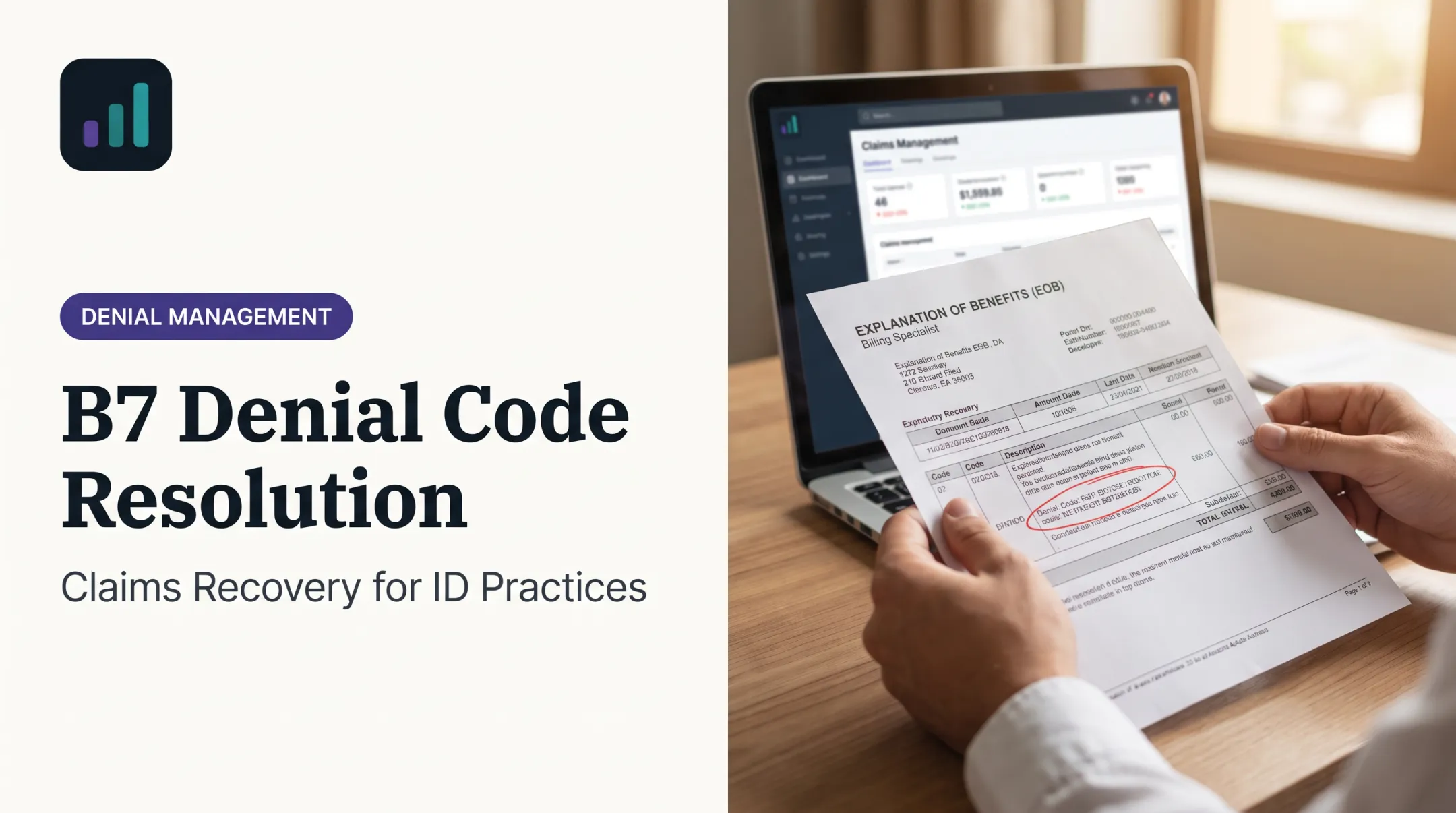
Read the remittance advice carefully. The denial code, remark code, policy reference, contractual adjustment, and appeal deadline all live there.
CMS's appeals guidance notes that a rejected Part B claim can usually be resubmitted, while an actual denial follows the formal appeals process. Confusing the two wastes your filing window.
Step 4: Choose Correction, Reconsideration, or Appeal
Match your response to the actual problem:
- Correct and resubmit for clear demographic, formatting, or coding errors
- Submit missing information when the payer explicitly requests it
- Request reconsideration for an apparent processing or contract error
- File an internal appeal for medical-necessity, coverage, or authorization disputes
- Consider external review only when the plan and applicable rules allow it
Follow the payer's written instructions exactly. Submitting the wrong pathway, or missing a step, can delay resolution or forfeit your appeal rights entirely.
Step 5: Submit, Track, and Close the Matter
A solid appeal packet includes:
- Denial notice, claim, and remittance details
- Relevant clinical records and authorization evidence
- Coding explanation and applicable payer policy language
- A concise argument tied to that specific policy, not general medical necessity
Document everything you submit and track:
- Submission date and delivery confirmation
- Payer reference number and assigned owner
- Follow-up date, response deadline, and outcome
Then ask whether the denial reflects a one-off error or a recurring workflow gap that needs a coding edit, an authorization checklist, or staff training.
Where the Process Applies and What Affects the Outcome
The claims and appeals process touches nearly every setting an ID practice bills from: office visits, inpatient consults, outpatient hospital services, infusion suites, OPAT oversight, drug administration, and facility-based or buy-and-bill arrangements.
It can be recurring (every billing cycle), condition-based (triggered by a specific denial), or episode-based, when several claims support one prolonged treatment course.
Factors that change the outcome:
- Payer and plan rules, including network status, contract language, and timely-filing windows
- Clinical documentation quality, diagnosis specificity, and consistency between the record, authorization, and claim
- Operational controls like eligibility verification, coding review, and denial ownership
- Financial characteristics: dollar value, probability of recovery, aging, and whether the denial hits a strategically important line like OPAT or infusion
Filing Windows Aren't Universal
Appeal deadlines and response times vary by payer, plan type, and jurisdiction. Original Medicare, for example, generally gives providers 120 days from receipt of the initial determination to request a redetermination, with a roughly 60-day decision window at that level, according to CMS's appeals guidance.

Medicare Advantage, Part D, and commercial ERISA plans each run on different clocks. Always confirm the controlling deadline in the denial notice or plan documents rather than assuming a standard timeline.
Metrics worth tracking, using your own data:
- Denial rate by payer and reason, measured in dollars, not just claim count
- Hard-denial dollars on drug claims, which represent realized inventory loss in buy-and-bill, not deferred revenue
- Corrected-claim rate, appeal rate, and overturn rate
- Days to resolution and aged receivables over 90 days
Count-based denial rates alone tend to understate exposure in infusion-heavy practices, where one denied drug claim can outweigh a month of office visit revenue.
Common Issues and Misconceptions
Most denials trace back to a short list of causes:
- Missing or expired authorization
- Eligibility changes between authorization and service
- Coding or modifier errors, and unit or wastage mismatches
- Incomplete clinical documentation
- Untimely filing or noncovered services
- Medical-necessity disputes on the specific drug or regimen used
A denial is not automatically a final refusal to pay, and an appeal is not simply a resubmission with a cover letter. The right response depends on the denial reason, the payer's specific instructions, and what evidence you actually have.
Be careful with assumptions, too:
- A high denial rate doesn't prove payer misconduct
- Not every denial is appealable
- An appeal is not a guarantee of payment
- A marketplace-wide denial rate won't predict your practice's recovery rate
According to HFMA's denial metrics report, aggregate denial data often combines different claim types, markets, and reporting methods, which limits how comparable those figures really are.

When Appeal Isn't the Right Move
Skip the formal appeal and submit a correction instead when the issue is a clear demographic, formatting, or coding error.
Loop in contract, compliance, or legal review before proceeding on exclusions, suspected overpayment, recoupment requests, or repeated medical-necessity disputes on the same drug.
For low-dollar disputes, weigh expected recovery against the filing deadline, staff time, and documentation burden before committing resources. Not every claim is worth the fight, and that's a legitimate business decision, not a failure.
Conclusion
Claims and appeals management is a controlled revenue-cycle workflow, not a single form or an isolated billing task. What separates practices that recover revenue from those that write it off is disciplined execution across a few controls:
- Accurate documentation
- Payer-specific triage
- Deadline control
- Consistent tracking
Apply your own payer mix, service-line data, and staffing numbers when deciding where to invest follow-up effort. GrowInfectiousDisease publishes free, ungated tools, including the Independent ID Practice Economics Calculator, to help you model those figures yourself. These are economics resources, not a service that files or manages appeals on your behalf.
Frequently Asked Questions
What is a claims appeal?
A claims appeal is a formal request for a payer to reconsider a denied or otherwise adverse claim decision. The required evidence, review level, and deadline all depend on the specific payer, plan, and contract involved.
How long does an appeal process usually take?
Timing varies by payer, claim type, urgency, and whether it's an internal or external review. Check the denial notice, plan documents, or payer policy for the controlling deadline and expected response period.
Do people usually win appeals?
Outcomes vary, and no universal success rate applies across payers or claim types. Documentation strength, denial validity, and payer rules all matter, so track your own historical overturn and recovery data instead of relying on published averages.
Are claims and appeals the same thing?
No. A claim is the initial request for payment, while an appeal challenges an adverse decision made on that claim. Corrections and reconsiderations are often separate steps that come before a formal appeal.